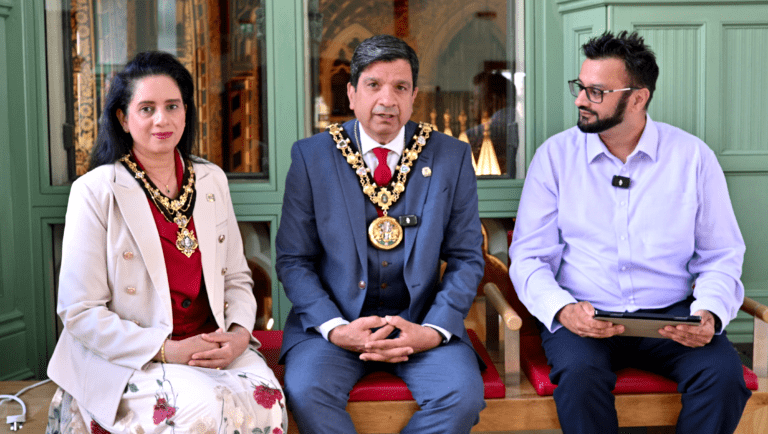
In this conversation, we reflect on the life journey of Haji Sufi Muhammad Ramzan Naqshbandi, a respected figure whose story spans from the villages of Azad Kashmir to the communities of the United Kingdom. His life is a powerful example of faith, perseverance, and dedication to serving others through religious education.
Sufi Muhammad Ramzan begins by recalling his early years in Azad Kashmir. Although he mentions that his memory is not as strong as it once was, he shares glimpses of a simple upbringing surrounded by family. He grew up with his parents and several siblings, though the pain of losing some brothers and sisters at a young age remained a part of his life. His elder brother Haji Muhammad Pehalwan Khan Naqshbandi had already moved to the UK, which later became a turning point for him as well.
In the mid-1960s, preparations began for his journey abroad. In 1967, he travelled to the United Kingdom, following in the footsteps of his elder brother Haji Muhammad Pehalwan Khan Naqshbandi who had invited him. The journey itself was long and demanding. He travelled within Pakistan before flying from Karachi to London, and from there continued on to other towns. Eventually, he settled in different areas as he adjusted to life in a completely new country.
Those early days in the UK were not easy. Life was very different from today, with limited communication and few resources. There were no mobile phones or instant messaging, and people relied on letters to stay in touch. At one point, a postal strike meant that news from home was delayed for weeks, and even the news of a loved one’s passing reached him long after the event. These were difficult moments that tested patience and resilience.
Despite these challenges, he slowly found his footing. One of the most significant turning points in his life came through his connection with the mosque. In Azad Kashmir, he had not been able to complete his Quranic education despite making several attempts. However, after arriving in the UK, he found the opportunity to begin again. Under the guidance of dedicated teachers, he completed his Nazra and went on to memorise portions of the Quran. This achievement marked the beginning of a lifelong journey in خدمة (service) to the Deen.
As time passed, he was given the opportunity to teach. What began as assisting his teacher gradually turned into a full commitment to educating children. He devoted himself to teaching the Quran to both boys and girls, helping them learn to read, understand, and connect with the holy text. Over the years, countless students passed through his classes, many of whom completed their Quranic studies under his guidance. For him, teaching was not just a responsibility but a deeply meaningful act of عبادت (worship).
Balancing life was not easy. Alongside his teaching, he attended school and worked to support himself. His daily routine was demanding, often involving work during the day and teaching in the evenings. Yet, he remained consistent in his prayers and committed to his responsibilities. This discipline shaped his character and strengthened his connection with faith.
He also speaks about the strong sense of community among early immigrants in the UK. People supported one another, shared resources, and built a sense of unity in unfamiliar surroundings. There was a spirit of cooperation and sincerity that helped them overcome many of the hardships they faced.
A particularly powerful moment in his life came when he read a line in a book stating that a person who possesses knowledge but does not share it will be held accountable before Allah. This message deeply affected him. He made a sincere prayer, asking Allah to give him the ability to pass on whatever knowledge he had. He believes that this prayer was accepted, as he was given the opportunity to teach and guide so many students over the years.
Later in life, he faced serious health challenges. Around 2014, he underwent a major operation related to his spine. The situation was critical, and there were concerns about long-term disability. However, by the grace of Allah and the prayers of those around him, the operation was successful. His recovery was not easy, but it strengthened his ایمان (faith) and gratitude.
Throughout his life, he also had the blessing of performing Hajj and Umrah multiple times. These journeys further deepened his spiritual connection and reinforced his commitment to living a life of purpose and devotion.
Reflecting on his experiences, he emphasizes the importance of prayer, sincerity, and staying connected to the mosque. He reminds us that this world is temporary and that many of those who were once close to us have already returned to Allah. Life, he says, is about preparing for the hereafter through good actions and service to others.
He concludes with a heartfelt dua, asking Allah to grant everyone the ability to perform good deeds, to remain steadfast in prayer, and to elevate the ranks of those who have passed away. It is a reminder of humility, gratitude, and the enduring value of faith.
Ameen.