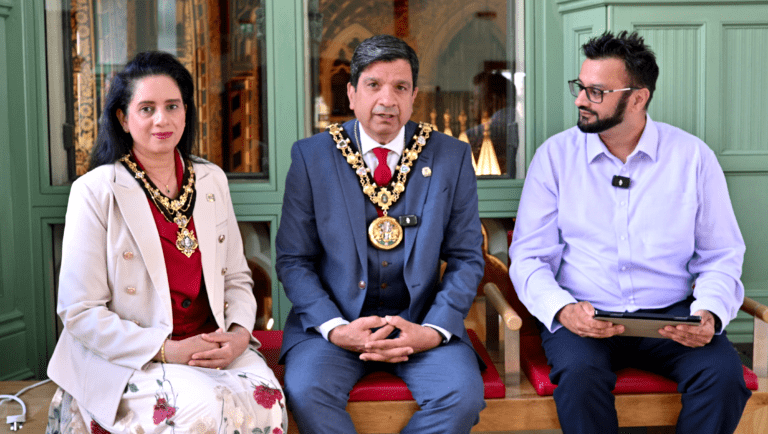
Kashmir Youth Project (KYP) has been shaping lives in Rochdale for decades. For many local people, it has been more than a building or an organisation — it has been a place of opportunity, guidance and community.
During a recent visit to KYP, Chief Executive Zulf Ahmed reflected on his own journey, the organisation’s history, and the lasting impact it has had across generations.
After leaving sixth form college, Zulf completed his A‑levels but was unable to go to university because of personal circumstances. Through local contacts, he was introduced to Kashmir Youth Project and encouraged to volunteer.
At the time, KYP recognised the potential of young people in the community. When a position became available, Zulf and another young applicant, Abdul Hamied — a graduate in electronic engineering from Sheffield Hallam University who was also experiencing difficulties securing employment — were both offered the role. Rather than choosing one candidate, the management committee created a shared opportunity, allowing both to gain experience while working part‑time.
That decision became the foundation of Zulf’s career.
Zulf began as a training officer, enrolling new recruits, supporting workshops and helping manage day‑to‑day operations. Over time, he progressed through the organisation, later becoming deputy manager and then Chief Executive — a role he would return to on two separate occasions. He credits Kashmir Youth Project with giving him the skills, confidence and practical experience that shaped everything that followed.
His career later expanded into wider education and public service. He worked with the Training and Enterprise Council, managing post‑16 education funding, before moving into the Learning and Skills Council, where he worked across Greater Manchester. There he managed large education budgets, supported development planning with colleges, and gained valuable insight into how government, education policy and public services operate.
In 2010, he returned to Rochdale and joined the local authority as 16–19 Manager. One of the major projects during that period was helping to establish Rochdale Sixth Form College.
At the time, many young people were leaving Rochdale to study elsewhere. The creation of a local sixth form college gave young people the opportunity to continue their education closer to home, while also helping the town retain local talent. Today, Rochdale Sixth Form College is widely recognised as one of the borough’s strongest educational success stories.
A few years later, Kashmir Youth Project was facing a difficult period. Like many voluntary and community organisations, changes in funding had created uncertainty. The management committee invited Zulf to return as Chief Executive.
He felt a responsibility to come back.
KYP had helped build his career, and he believed it was time to give something back. He spent the next five years rebuilding stability, strengthening foundations and helping the organisation move forward once again.
After that period, he joined Rathbone Training, part of the Newcastle College Group (NCG), one of the largest providers of post‑16 education and training in England, as National Development Manager. At the time, Rathbone Training operated a national network of around 19 centres, the majority based in England, delivering post‑16 education and apprenticeship provision. When the organisation later closed, Zulf oversaw the transfer of around 2,500 learners, managed the closure of 15 centres and helped staff transition into new roles.
Following the pandemic, he worked in the Department for Education as a senior policy adviser, contributing to educational policy development and working with ministers and senior civil servants.
Yet despite the scale of that work, something was missing.
He found himself increasingly drawn back to community work — to seeing the direct impact of helping people locally.
When Kashmir Youth Project once again asked him to return as Chief Executive, he accepted.
For Zulf, the rewards of community work go beyond salary or status. The real value lies in seeing people progress, develop confidence and move forward in life.
A Place That Helped Shape Generations
For many people in Rochdale, KYP has played a deeply personal role.
Former participants remember arriving at the organisation as school leavers, often uncertain about what direction to take next. The Youth Training Scheme gave young people structure, purpose and the chance to experience different pathways before moving on to college or work.
At its peak, the original KYP building employed around 20 staff and offered six or seven workshops. These included motor vehicle training, electronics, sewing, printing, building trades, IT and business administration.
The programme offered much more than a weekly allowance. It helped young people discover what suited them, what did not, and where their strengths lay. It also helped them develop habits that would become essential later — commitment, responsibility, confidence and self‑motivation.
Alongside youth training, KYP also supported unemployed adults through vocational qualifications, providing Level 1 and Level 2 opportunities that improved employability and created pathways back into work.
That legacy continues today. In the last year alone, 936 adults acquired new skills through KYP’s adult education programmes, including digital skills, childcare, health and social care, maths, English and ESOL, supporting progression into further learning and employment.
More Than Training
Kashmir Youth Project has always been wider than education alone.
Over the years, it has offered childcare, welfare advice, youth activities, sports facilities and social support for older residents. Many local families still remember the organisation’s welfare service, where practical help with forms, advice and guidance often made an immediate difference in people’s lives.
Today, that support continues to evolve.
Over the past year, KYP supported 2,434 people, an increase on the previous year. Advice and welfare services are delivered across Rochdale, Middleton and Heywood through outreach points including community centres, GP surgeries and local organisations.
In 2024/25, this work helped residents access over £1 million in public support they were entitled to, at a time when many households were facing increased financial pressure.
Alongside advice, the organisation continues to provide:
- an on‑site nursery through Little Gems, supporting parents into work and training
- a community food pantry offering culturally appropriate food
- IT classes
- childcare training
- health and social care courses
- ESOL programmes
KYP also operates as a community hub. Its facilities host cultural, community and professional activity, and the Unique Enterprise Centre now houses nine organisations collectively employing around 350 staff.
Supporting Older People
One of the areas now receiving major attention is support for older people.
KYP runs weekly community sessions for people over 50. Women meet on Tuesdays and men on Wednesdays, providing social connection, health advice, wellbeing support and gentle exercise. Visiting professionals regularly offer advice on issues such as diabetes, blood pressure, cancer awareness and mental health.
This work is complemented by targeted support for older residents returning home from hospital. Over the past year, KYP delivered 44 Home from Hospital sessions and carried out 30+ home visits, offering emotional and practical support, food parcels, home safety checks and referrals into health and housing services.
For many older people, this support offers something extremely important — familiarity, dignity and trust.
Investing in Young People Again
Another major priority is apprenticeships.
KYP previously played a significant role in apprenticeship delivery, and Zulf believes this is an area that must return. Apprenticeships provide practical experience, skills development and access to employment across a wide range of sectors.
Alongside this, employability support remains a core part of KYP’s work, helping people move into employment, further learning and voluntary work across Greater Manchester.
A Legacy of Leadership
One of the most powerful aspects of the Kashmir Youth Project story is the legacy it has created — through its founders, its alumni and the generations it has supported.
KYP was established in 1979 by Lord Qurban Hussain, Shabir Hussain, Mohammed Habib Ullah and Noor Hussain, at a time when Rochdale was facing profound economic change following the decline of the textile industry. Their shared vision was to support local people through opportunity, skills and community action, particularly when traditional routes into employment were disappearing.
Over the decades, KYP has helped shape generations of leaders. Former participants, apprentices, volunteers and staff have gone on to become peers, ministers, councillors, senior officers and community leaders across public service, education, health and the voluntary sector.
This legacy was recently highlighted when two of the organisation’s founders, Lord Qurban Hussain and Shabir Hussain, returned to KYP nearly five decades after helping establish it.
Reflecting on the organisation’s journey, Lord Qurban Hussain said:
“KYP was built on hope, opportunity and community. To see that vision not only alive, but expanding into employment, digital inclusion, wellbeing and so many other areas is deeply moving. I’m proud that it has stayed true to its founding values while continuing to adapt to the needs of today’s communities.”
Today, under the leadership of Chief Executive Zulf Ahmed, himself a former participant, KYP continues to carry forward that founding vision — supporting new generations to progress, contribute and lead.
Looking Ahead
Kashmir Youth Project continues to adapt to changing times, but its purpose remains clear: to strengthen communities, create opportunity and support people at every stage of life.
For Zulf Ahmed, the future is rooted in both younger and older generations — creating better support for elderly residents while opening stronger pathways for young people through skills, apprenticeships and guidance.
.The more a community is supported, educated and empowered, the more prosperous its future will be.