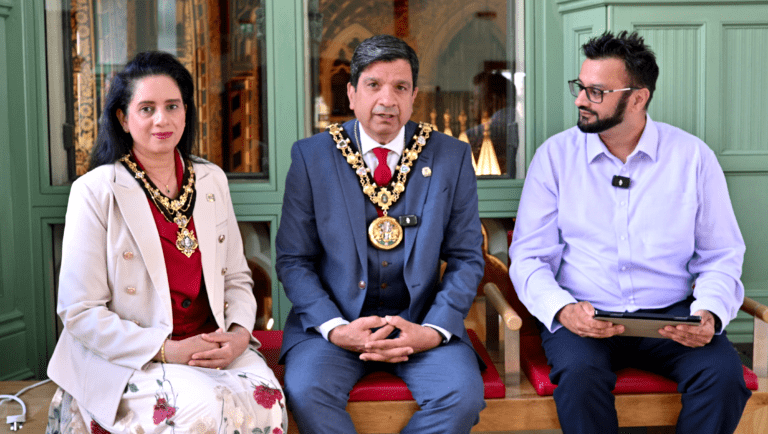
Ghulam Rasul Shahzad’s journey is one of dedication, education, and tireless service to the community. Born in India before his family migrated to Pakistan, he spent his childhood and education in Lahore, a city he describes as vibrant, busy, and deeply connected with learning and culture. After completing his law degree and postgraduate studies in Islamic Studies in Pakistan, he arrived in the United Kingdom in August 1976 with ambitions to continue his education and pursue an LLM degree.
Arriving in Rochdale marked the beginning of a completely new chapter in his life. The transition from Lahore to the UK was significant, with a very different culture and way of living. However, Shahzad was fortunate to have family already settled in the area, including his eldest sister, which helped ease his arrival. Sadly Ghulam’s eldest sister passed away in Manchester recently.
Like many immigrants of that generation, he began working hard immediately. He found employment in a local factory and quickly impressed management with his educational background and determination to learn. Recognising his potential, they supported him through management training and professional development courses. He later qualified as a training instructor, gaining valuable experience in public speaking and leadership.
Reflecting on the early Pakistani and Kashmiri communities in Rochdale during the late 1970s, Shahzad remembers how scattered and isolated people were. Many had arrived from rural villages with the hope of earning money to support families back home in Pakistan, Kashmir, and India. He credits his mother as his greatest inspiration and teacher throughout his life.
With his educational background in Islamic Studies, Shahzad soon began teaching children at local mosques. During those early years, Rochdale had very limited Islamic facilities, with only a handful of mosques serving the growing Muslim population. He became involved in fundraising efforts to purchase and convert a church into a mosque, helping create an important place of worship and learning for the community.
As the Muslim population in Rochdale continued to grow, Shahzad recognised the wider social and educational challenges facing families. He volunteered his services to support local residents through a community-based action area project aimed at improving housing conditions. At the time, many homes lacked central heating and indoor toilets. Working alongside council officers, he helped families complete applications and access support services entirely free of charge.
This grassroots work gave him important insight into the future needs of the community. He realised that as families expanded, there would be increasing demand for community centres, educational services, and cultural support for younger generations.
One of Shahzad’s most important contributions was his campaign to preserve and teach the Urdu language to children growing up in Britain. Despite facing resistance from some education officials who believed children should focus only on English, he passionately argued that maintaining their mother tongue was essential for communication with family members and preserving cultural identity. As a Training and Development Officer for Rochdale Borough Council, he designed and delivered very successful Urdu training sessions for Council staff, Greater Manchester Police and Greater Manchester Fire staff.
His efforts led to the creation of the Urdu Action Committee, which successfully campaigned for Urdu language teaching in local schools. Eventually, Urdu was introduced into four schools in Rochdale. Shahzad also became involved in training council staff and delivering cultural awareness programmes, helping bridge understanding between communities.
Alongside his community work, Shahzad developed a deep interest in history, education, and cultural relations. He often spoke about the historical development of Urdu and the influence of British colonial administration in South Asia, explaining how education systems, local government structures, and democratic institutions evolved over time. While acknowledging the difficult realities of colonialism, he also believed it was important to recognise the lasting infrastructure, education systems, and institutions that shaped modern South Asia.
Over the years, Shahzad became heavily involved in civic leadership and international relations projects, particularly through Rochdale’s town twinning initiatives. He played a key role in establishing the twinning relationship between Rochdale and Sahiwal in Pakistan during the late 1980s. Working alongside local councillors and community leaders, he helped build cultural and professional links between the two towns.
The twinning partnership led to a wide range of projects, including educational exchanges, waste management initiatives, healthcare training, and local government collaboration. One of the most successful programmes involved improving maternity healthcare services in Pakistan. Through training and partnership work, the project significantly reduced maternal death rates and became internationally recognised for its impact.
Throughout these initiatives, Shahzad remained committed to transparency and public service, always paying for his own travel expenses when visiting Pakistan as part of community delegations.
His contribution to Rochdale extended far beyond cultural and educational work. He also played a role in celebrations marking the 150th anniversary of the cooperative movement in 1994. Rochdale, recognised globally as the birthplace of the cooperative movement, hosted major events and international visitors during the celebrations. Shahzad proudly participated in organising community activities and represented the Muslim community during cultural events held across the town.
A passionate advocate for Rochdale’s heritage, Shahzad believes the town’s rich history deserves greater recognition. He often highlights notable figures connected to Rochdale, including Gracie Fields, John Bright, and pioneering scientists and reformers whose achievements shaped both Britain and the wider world.
He also remains deeply committed to environmental improvement and civic pride. Inspired by visits to Germany through the twinning programme, Shahzad became determined to promote cleaner streets, greener neighbourhoods, and stronger community ownership of public spaces. He has actively encouraged residents to improve local environments through gardening, flower planting, and community clean-up projects.
One particularly proud achievement came when five Rochdale mosques received recognition from the Royal Horticultural Society for their environmental and gardening efforts. Shahzad viewed this as a major milestone, demonstrating the positive role faith institutions can play in improving local communities.
Despite decades of achievements, leadership roles, and public recognition, Shahzad describes himself simply as “a lifelong student.” He continues to learn from people around him, share knowledge through local radio broadcasting, and contribute to civic life with humility and dedication.
For Ghulam Rasul Shahzad, true success is not measured by wealth or status, but by the good deeds left behind for future generations.