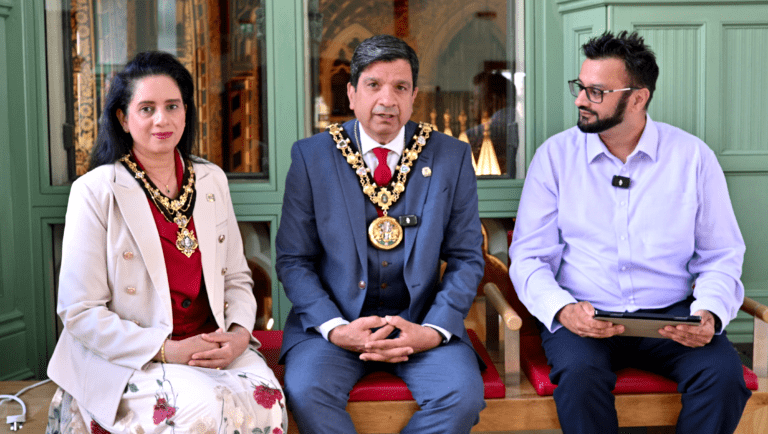
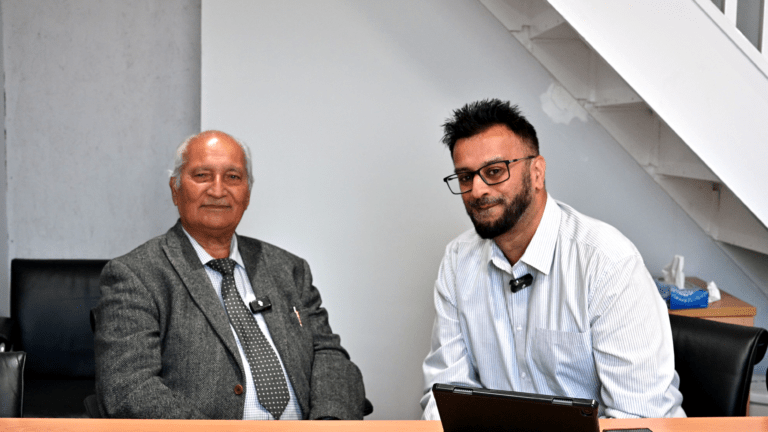
The podcast features a conversation with Iftikhar Ahmad Rizvi, a Sunni Muslim community figure visitng in Britain from Pakistan, who discusses his upbringing in Pakistan, his religious journey, the role of young people, the importance of preserving language and culture, the Muslim community in Britain.
Later in the interview, Imran Ghous joins the conversation and shares his own experiences of living in Britain and working with young people and the wider community.
Iftikhar Ahmad Rizvi: His Background and Religious Journey
Iftikhar Ahmad Rizvi begins by expressing his gratitude for the opportunity to speak and for the platform through which his message can reach people around the world.
He introduces himself as Iftikhar Ahmad Rizvi and explains that he belongs to the Sunni tradition and follows the teachings and traditions associated with the Ahl al-Sunnah wa’l-Jama’ah. He says that his religious work is centred around respect, devotion and love for the Prophet Muhammadﷺ , and that he has spent many years taking part in Milad-un-Nabi gatherings and other religious activities.
He explains that he was born and raised in Shahkot, in the Faisalabad region of Pakistan. His childhood and early education were spent there before he continued his studies at college.
From an early age, he says, he was attracted to religious and cultural activities. Programmes were regularly held in schools and colleges, including recitation of the Qur’an, poetry, religious gatherings and other activities involving young people. These experiences gradually developed his interest in religious service and public engagement.
He reflects on the importance of parents in shaping a child’s character. In his view, a mother’s lap is the first educational institution for a child, while the influence of a father also plays a crucial role in developing a young person’s personality, values and direction in life.
The Importance of Role Models
Iftikhar explains that every person tends to have role models whom they admire and follow. When he was young, he looked up to respected religious personalities and scholars and observed their way of life closely.
He says that he did not simply listen to their speeches; he watched how they lived, how they interacted with people and how they devoted their lives to religion and the community. Their example created a desire within him to follow a similar path.
He contrasts this with the modern tendency for young people to follow actors, singers, politicians, sports personalities and other celebrities. While there is nothing inherently wrong with admiring successful people, he believes young Muslims should also have positive religious and moral role models.
For him, following the example of respected religious figures provided a sense of purpose and direction.
The Muslim Youth of Britain
A significant part of the discussion focuses on young Muslims in Britain.
Iftikhar says he has been impressed by seeing young people in Britain participating in Milad gatherings, religious programmes and events connected with the Seerah of the Prophet Muhammad ﷺ.
He describes seeing British-born youngsters taking part in religious gatherings with enthusiasm, reciting poetry and expressing their love and respect for the Prophet Muhammad ﷺ. To him, this demonstrates that many young Muslims in Britain remain connected to their faith despite growing up in a very different environment from Pakistan.
He says that he has seen thousands of young people attending religious programmes and believes their enthusiasm deserves recognition.
According to him, the commitment of these young people gives hope to the Muslim community in Britain.
Preserving Language, Culture and Identity
Iftikhar also stresses the importance of parents passing their language, culture and religious values on to their children.
He says that many children attend British schools where English is naturally their main language. However, he believes that the home environment should also expose children to their family’s heritage.
He encourages parents to teach their children Urdu, Punjabi or Kashmiri, depending on their family background, alongside English.
He argues that learning one’s mother tongue can help young people maintain a connection with their heritage, their families and their cultural identity.
He does not suggest that children should avoid English. Instead, he believes there should be a balance: English is essential for life in Britain, but children should also understand the language and traditions of their parents and grandparents.
He suggests that families could dedicate regular time at home to teaching children their heritage language, religious knowledge and cultural traditions.
Religious Programmes and Community Work in Britain
The conversation also turns to the numerous religious programmes being organised across Britain.
Iftikhar praises organisers, scholars and community members who continue to arrange gatherings despite busy lives and other pressures.
He says that Britain provides many opportunities for people to practise their faith, and he has seen community members make considerable efforts to organise religious events and bring people together.
He particularly appreciates the hospitality shown to visiting scholars and religious personalities from Pakistan and elsewhere.
He believes these relationships have helped strengthen connections between communities in Britain and Pakistan.
Imran Ghous Joins the Conversation
Later in the interview, Imran Ghous joins the discussion.
Imran explains that his roots are in Lahore, Pakistan, and that he has been living in England for approximately two and a half years. He describes his involvement in community gatherings and programmes, particularly those involving children and young people.
He says that much of his work has involved creating opportunities for young people to participate in religious and cultural programmes.
Imran speaks warmly about the people he has met in Britain and the relationships he has developed within the community. He also expresses gratitude to those who have supported him and helped him establish himself after moving to England.
He says that the hospitality and affection shown by people in the community have made a significant impression on him.
The Importance of Giving Time to Others
The discussion highlights the importance of making time for other people.
The speakers acknowledge that Britain is a country where people can have many opportunities and material comforts, but finding time for others can sometimes be difficult.
They praise members of the community who make an effort to welcome visitors, support new arrivals and help people who may be struggling.
They describe this spirit of hospitality as an important part of Islamic and cultural values.
For them, community work is not simply about organising events. It is also about building relationships, supporting families and ensuring that people do not feel isolated.
The Positive Role of Journalism and Social Media
Towards the end of the discussion, Iftikhar and Imran Ghous praise Amjad about his work in journalism and community media.
He describes journalism as a serious responsibility, comparing it with professions that carry a moral duty towards society.
In his view, journalism can become a form of service when it is carried out honestly and with sincerity.
He says that responsible media can help protect younger generations, promote peace and encourage people to contribute positively to the countries in which they live.
He believes social media has an especially important role to play because of its ability to reach young people directly.
However, he warns against using social media to spread negativity, hostility or division.
Instead, he encourages content creators to use their platforms to promote positive messages.
A Message to Muslims Living in Britain
Iftikhar concludes by encouraging Muslims living in Britain to respect the country in which they live and to contribute positively to society.
He believes that Muslims should maintain their religious and cultural identity while also being responsible and peaceful members of British society.
He stresses that wherever people live, they should seek peace, respect the law and avoid creating conflict.
The interview ultimately presents a discussion about faith, identity, community service, young people, cultural heritage and the responsibilities of Muslims living in Britain.
For Iftikhar Ahmad Rizvi and Imran Ghous, the central message is clear: young people need positive role models, families should preserve their language and heritage, social media should be used responsibly, and communities should work towards peace rather than division.