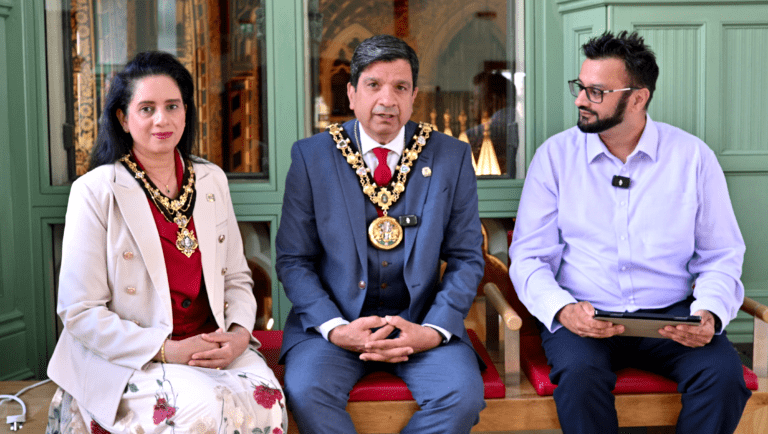
Muhammad Siddique Kosar shared a heartfelt account of his life, upbringing, religious journey, and decades of service to the Muslim community in Pakistan and the United Kingdom.
Muhammad Siddique Kosar began by expressing gratitude and love for the people gathered around him, including friends, imams, and khateebs, acknowledging the respect and affection they had shown him throughout his life.
Muhammad Siddique Kosar explained that he was originally from Rajdhani village in Azad Kashmir. He was born before the creation of Pakistan and opened his eyes in a deeply religious and scholarly household. His father, Mian Nizamuddin Qureshi, served as the imam of the village and actively participated in the Pakistan Movement.
At that time, education facilities in the region were limited, with schooling available only up to the fifth grade. He completed his early education there, but tragedy struck early in life when his mother passed away while he was still in the second class.
After her passing, he moved to Samror in Azad Kashmir to live with his aunt. There, he continued his schooling and simultaneously began studying Persian and Arabic under the guidance of the respected scholar Maulana Baqa Muhammad Sahib. Alongside formal education, he would study religious texts and basic Arabic and Persian literature with great dedication.
Later, his father sent him to pursue formal Islamic studies. He first enrolled at Jamia Rizvia Ghausia in Rawalpindi, where his admission was arranged by respected religious figures connected to Eidgah Sharif. However, illness interrupted his studies, forcing him to return home for a period of recovery.
Despite recurring health issues, he continued his educational journey in Jhelum and later spent some time in Lahore. In Jhelum, he studied under distinguished scholars such as Qazi Ghulam Mahmood Sahib, Maulana Muhammad Ayub Hajravi Sahib, and the renowned Qari Hafiz Muhammad Saeed Sahib, who also taught the late Khadim Hussain Rizvi.
As his religious education progressed, he was appointed imam and khateeb of a newly built mosque in the Talyanwala area of Jhelum. He recalled leading the very first Eid prayer there at a time when there was no electricity, and loudspeakers operated on batteries. The mosque gradually became a central gathering place for the Sunni Muslim community, attracting worshippers from distant areas for Friday prayers.
He served there for twelve years, describing those years as some of the most beautiful and fulfilling of his life.
Speaking about his family, Muhammad Siddique Kosar shared that he had four brothers and two sisters. Over time, all of his siblings passed away, leaving him as the sole surviving member among them. He later married in Jhelum and eventually migrated to the United Kingdom in 1983.
Upon arriving in the UK, he joined the Madina Islamic Centre on Whitworth Road in Rochdale. Community leaders including Raja Zar Khan and Haji Punnu Khan invited him to serve the growing Muslim population. At the time, he already had an established life in Pakistan, including responsibilities as an imam and ownership of a bookstore and stationery shop.
Initially hesitant due to hearing about disputes within some mosques, he eventually agreed to come after being reassured by community members. In the UK, he focused heavily on teaching children and spent five years educating around sixty boys and girls daily at the Madina Islamic Centre.
Later, he became associated with larger mosque activities in Wakefield, where the Muslim community was still developing. He reflected on the challenges faced by early Muslim communities in Britain, particularly disputes regarding mosques, moon sightings, Ramadan, and Eid celebrations.
Muhammad Siddique Kosar spoke proudly about the efforts made to unify the Muslim community through mosque councils and Milad committees. He credited religious scholars, community leaders, councillors, doctors, and social figures for bringing people together. Through meetings and collective consultation, they eventually established unity regarding the beginning of Ramadan and Eid celebrations, ending years of division.
He paid special tribute to the late Muhammad Azam Chishti, remembering him as a visionary figure who helped organise Milad gatherings and religious processions in the community. Together, they laid foundations that continued to grow over the years with the support of organisations such as Dawat-e-Islami and local mosque councils.
Muhammad Siddique Kosar also discussed his deep spiritual connection with Chura Shareef and its spiritual leaders. His family had longstanding ties with the shrine and its Sufi tradition. He recalled accompanying senior spiritual figures during their visits and later formally entering the spiritual path himself through bay‘ah.
He described emotional memories of attending Urs gatherings, participating in ceremonial rituals, and receiving spiritual guidance from respected pirs. These experiences shaped his religious outlook and strengthened his lifelong devotion to Islamic scholarship and spirituality.
In 1992, he became connected with Jamia Haideria, where he continued serving the community through sermons, Friday prayers, and religious teaching despite severe health struggles. He recalled periods when he was physically so weak that people had to assist him to the pulpit, yet he continued delivering sermons and serving the community with determination.
Throughout his life, he focused his sermons on practical Islamic guidance according to the occasion and season — speaking about Muharram, Ramadan, Hajj, sacrifice, repentance, and other important aspects of faith. In later years, he also began sharing Islamic teachings through radio programmes.
Toward the end of the conversation, he fondly remembered Haji Muhammad Pehalwan, praising his kindness, concern, and companionship during religious journeys, including a memorable trip to Iraq. He spoke emotionally about his passing, praying for Allah to elevate his status and remembering his close attachment to Jamia Haideria and Chura Shareef and Hazrat Baba Jee Pir Syed Muhammad Shabeer Ali Shah Gillani Naqshbandi Mujaddidi.
Muhammad Siddique Kosar concluded by reflecting on how certain individuals leave behind an irreplaceable void when they pass away. While acknowledging that life continues and communities move forward, he emphasised that the contributions, sincerity, and love of some people are never forgotten.
His story stands as a powerful testimony of faith, scholarship, resilience, and lifelong service to the Muslim community across generations and continents.